
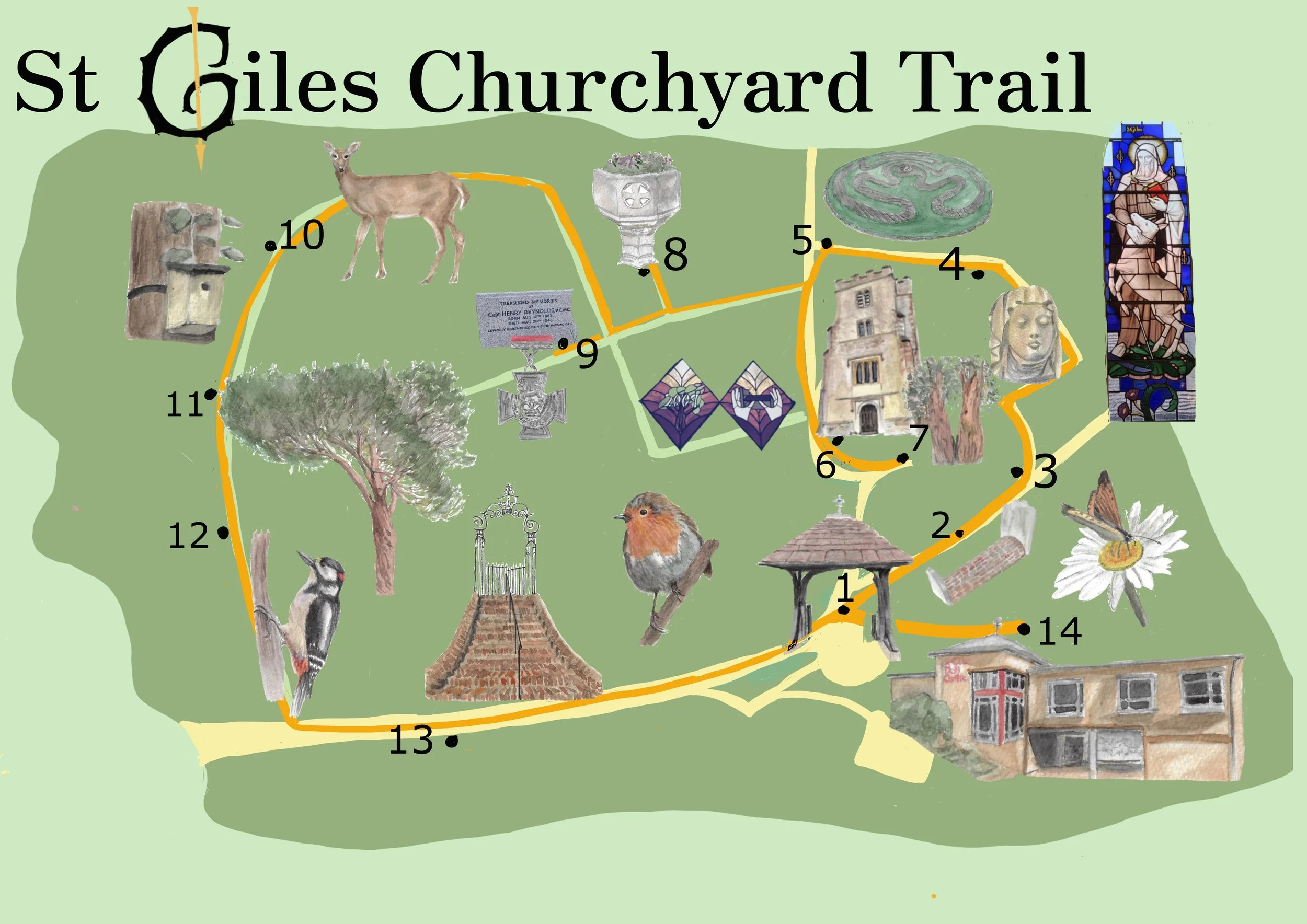
Welcome to the St Giles’ Churchyard Trail
Dogs are welcome on the trail but please keep them on a lead.
Some of this trail is on uneven ground
-
St Giles Church has been here since 1115 when it was originally a private chapel. You are starting the trail at the Lychgate: The word comes from the old English word “lych” meaning corpse. The gate was traditionally used as a resting place for pall bearers with the coffin as the priest performed the first part of the burial service. It marks the boundary between consecrated and unconsecrated ground. St Giles is a medieval saint who renounced his wealth to live as a hermit in the forest. He befriended a deer and became wounded when the king’s huntsman tried to shoot this deer. The king offered to look after him whilst he recovered and during this process the king invited him to set up a monastery.
-
Look at the unusual brick vaulted tombs which were built in the 18th and 19th centuries. Wealthy people built them so that the coffin could be placed in a brick built box set in the ground with the arched vault that you can see on top. They were built to prevent body snatchers and also to stop the grave subsiding, as that often happened when a coffin collapsed underground.
-
At this point you can see the way that the church has been added to at different times. The church was extended in the 13th century with a new chancel. It was also restored and enlarged in 1830. The East window is from a french abbey made in the 15th or 16th century and gifted to the church in 1824.
-
With your back to the church you are now looking at an old wall which was part of a medieval manor house. It was still there in the 18th century but when a new manor house was built, which now forms part of the City of London Freeman’s school, the old Manor House became farm outbuildings including a dairy. This wall is all that remains and includes some building materials from Roman times.
-
This is a Prayer labyrinth which you can use to help you pray. Prayer is important for Christians because it is how they communicate with God. Please look at the sign if you would like to use the labyrinth for prayer or you could sit on the bench for a while to pray or to just enjoy being still.
-
You will see two contemporary stained-glass windows set in the window on your way to the main door of the church. They were created in 2009 to commemorate the restoration of the church. The tree represents new growth and the church being held in hands represents a vision of God holding his church in his hands for future generations.
-
Stop at the main entrance to church and look up at the tower. There are 8 bells in the tower which are rung to call people to come and worship together on Sundays or to commemorate special events such as weddings or the coronation. A group of bell ringers meet each week to practice. To the side of the church entrance is a special Yew tree called a fragmented yew. Yew trees are often found in churchyards. This one may be old enough to have been there before the church building. Over time it began to collapse and has now grown into two parts.
-
This is an old font which was removed from St. George’s church when it was replaced with a more contemporary one. A font is used to baptise babies by sprinkling them with water as a sign that they are joining the church family. St George’s church is the daughter church of St Giles built in 1906 on Barnett Wood Lane to serve the expanding population of Ashtead. Both churches are part of the same parish with the same clergy team.
-
This is the grave of captain Henry Reynolds who was awarded the Victoria Cross and Military cross in first world war. He was very courageous saving many at great personal cost. You can find out more about his story on Wikipedia. There are also a number of commonwealth war graves in the churchyard. More information can be found by accessing the burial grounds map via a QR code which you can find at the Lychgate.
-
There are many oak trees in the churchyard. Sometimes we get Oak Processionary moth in them. We aim to avoid treating the trees with chemicals and instead are trying to encourage the birds to eat the caterpillars by putting up bird boxes. There are many different bird varieties here such as nuthatches and woodpeckers. If you can hear birdsong and want to find out which birds are in your vicinity, try using the Merlin bird app.
-
This is an ancient track which feels like a ditch. It probably led to the old Manor House, but it could originally have been a roman track as there is evidence of roman remains around Ashtead such as the roman villa on Ashtead Common.
-
On your left and you will see an impressive old cedar tree. There are a few around the churchyard. There is one on the drive and a large one behind the Dell centre. There are also many other varieties of tree in the churchyard. If you are not certain what type of tree you are looking at, try using a plant identifying app such as iNaturalist.
-
As you are walking up the drive you will see some steps leading through a gate into the churchyard. These were built in memory A H Legget who was a soldier. You can read his details on the stone at the bottom of the steps.
-
You have now reached The Dell centre which is a new addition to the parish replacing an old hall. It was opened in 2016 and is used for both church and community activities. Go through the Lychgate and turn right along a path which leads to an area behind the Dell centre. Walk as far as the sundial. On your left is a grassy bank which was seeded with wildflowers to encourage pollinators such as bees and butterflies. Now return to Lychgate where the trail ends.
Thank-you for exploring this beautiful churchyard by doing the trail. We would appreciate any feedback you can give us.